A conundrum is a confusing or difficult problem, riddle, or paradox with no easy solution. The word is often used to imply that a dilemma exists. Well, a very real conundrum exists in the world of building codes, specifically regarding code interpretation and the enforcement of special inspections under Sections 1704.2.5 and 1704.2.5.1 of the International Building Code (IBC).
Different interpretations of parts of the IBC are not unusual, with misunderstandings of code acceptance criteria being commonplace. The hundreds of code sections are difficult to understand with vague narrative, and IBC Sections 1704.2.5 and 1704.2.5.1 probably reign as kings of this ambiguity.
Building Official: The officer or other designated authority charged with the administration and enforcement of this code, or a duly authorized representative.
Approved Agency: An established and recognized agency regularly engaged in conducting tests, furnishing inspection services, or furnishing product certification, where such agency has been approved by the building official.
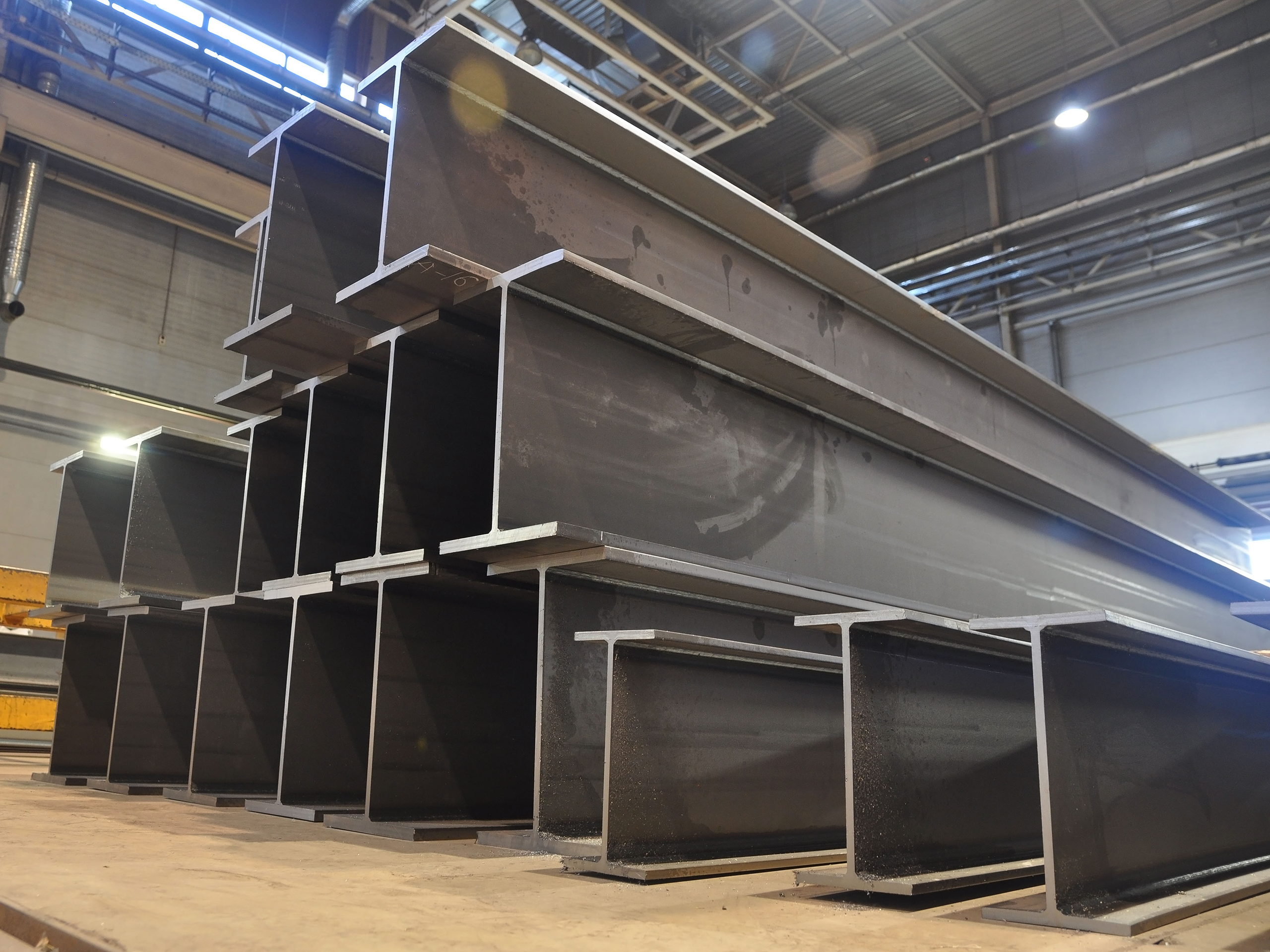
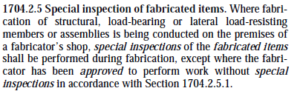
Section 1704.2.5 instructs the reader that special inspections shall be performed during the fabrication process, except where the fabricator has been approved to perform work without special inspections in accordance with Section 1704.2.5.1. The primary question raised in this code section is who approves the fabricator to perform the shop work without special inspections.
This question is answered by invoking the IBC definition of “approved fabricator,” which is defined as an “established and qualified person, firm, or corporation approved by the building official pursuant to Chapter 17 of the IBC code.” The code specifies that the building official (and ONLY the building official) decides which fabrication shops can produce project steel elements without special inspections being performed in the shop.
While the definition of approved fabricator clearly states that the building official makes the decision regarding which fabricators are approved for the project (IBC Chapter 2), the final words of the definition cannot be ignored: “…pursuant to Chapter 17 of the IBC code.” In other words, the building official can’t just approve the fabrication shop because he “feels good” about them or because the project registered design professional has no problem with them. There is a process, and there are rules regarding how you must approve any fabricator, all of which are summarized in Section 1704.2.5.1.
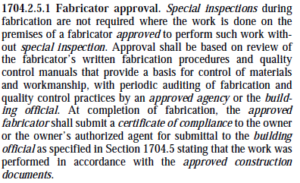
A single sentence in Section 1704.2.5.1 determines the approval of a fabricator. This key sentence is often unknown, misunderstood, or ignored by the individual who is approving the fabricator. It reads:
“Approval shall be based on review of the fabricator’s written fabrication procedures and quality control manuals that provide a basis for control of materials and workmanship, with periodic auditing of fabrication and quality control practices by an approved agency or the building official.”
The code requires a review of the fabricator’s quality control system and periodic auditing of fabrication and quality control practices before the fabricator can be approved. The fabricator’s QC system must be reviewed, along with in-shop auditing and documentation of past performance, to be designated as an approved fabricator under Section 1704.2.5.1. This QC system and auditing process review are often ignored during the fabricator selection process. It is important to emphasize that the American Institute of Steel Construction (AISC) requires that AISC Certified Fabricators undergo one unannounced in-shop audit annually. While the IBC code does not specify how many in-shop audits are required, IBC does adopt AISC 360 in Chapter 35 of the IBC code. The majority of agencies follow the minimum of one unannounced in-shop audit annually, but many still undergo at minimum two unannounced audits annually.
The IBC code requires special inspection at the fabrication shop premises for applicable fabricated items, except where the fabricator has been approved to perform work without special inspections (Section 1704.2.5). Approved by whom, you might ask? Only the building official can provide approval for a fabrication shop to perform work without special inspection.
Approved Fabricator. An established and qualified person, firm, or corporation approved by the building official pursuant to Chapter 17 of this code. (IBC Code, Chapter 2)
The Bottom Line: Special inspections shall be performed on all applicable building elements at the fabrication shop unless the building official of the jurisdiction where the project is to be built issues an exception in accordance with IBC Sections 1704.2.5 and 1704.2.5.1.
The requirement for special inspections on applicable building elements being fabricated at the fabrication shop must be complied with unless the building official issues an approval to the fabricator based on the requirements stipulated in IBC section 1704.2.5.1. There is widespread belief in the construction and design industry that an “AISC Certified Fabricator” gets a pass on the requirements of IBC Sections 1704.2.5 and 1704.2.5.1, but this is not necessarily true. The AISC Certified Fabricator must have the ability to submit proof of previous inspection audits (required by 1704.2.5.1) and previous unannounced shop inspection reports (by AISC or approved agency) to the building official so that the building official can make an informed decision on the fabrication’s QC system and material-handling experience.
The following does not comply with the intent of the code:
- Inspecting/touring the fabrication shop after the structural steel has been delivered to the project site. Frequently, a large percentage of the steel has already been erected. While field inspection of structural steel and welds (after shipment to the project) can be performed to some extent, some code-required inspection tasks cannot be done, and the fieldwork can become expensive for the owner.
- The special inspector visits a fabrication shop and submits a report while the shop is fabricating the steel elements for the Among other important code acceptance criteria, the requirement for periodic auditing is eliminated from the process.
- The special inspector inspects and tests the structural steel for a project after it has been delivered to the project site and then submits a report.
- The structural engineer in responsible charge approves the fabrication shop based on submittals that he has received from the Only the building official can approve the fabrication shop, with no special inspections occurring during fabrication.
- The building official approves a fabricator for exemption from special inspections at the fabricator’s shop without following the approval process. For the shop to be approved for exemption, there must be prior inspection tours by approved agencies as well as periodic auditing at least once annually.
- An AISC Certified Fabricator is not following the approval process. AISC Certified Fabricators do not receive a “pass” under IBC Section 1704.2.5.1. They, too, must receive an in-shop audit by an approved agency, and the report of that audit should be submitted to the building official for approval prior to the selection of construction professionals (including building officials).
The code verbiage in IBC Sections 1704.2.5 and 1704.2.5.1 could be clearer, for sure; however, the interpretations of this code narrative and the ignoring of code-acceptance criteria are far more damaging to the construction and design industry than the wordcraft of the code verbiage. Large amounts of structural steel are fabricated and shipped across the country from fabrication shops that are not approved by the building official (according to the code). If a fabrication shop begins steel fabrication for a new project without the building official granting them exemption from 1704.2.5 and 1704.2.5.1, then special inspections on those shop-fabricated steel elements should be provided at the fab shop.
_________________
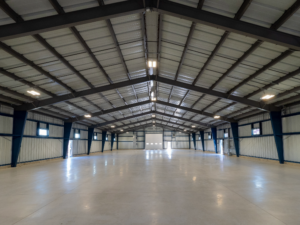
Pre-Engineered Metal Buildings (PEMB)
PEMB manufacturers should also comply with IBC Sections 1704.2.5 and 1704.2.5.1 during shop fabrication, just like all other steel fabrication shops. Larger PEMBs often include complete joint penetration (CJP) welds 5/16 inch or thicker, which are provided in the fabrication shop. PEMBs with these CJP shop welds are often shipped to the project site without ever having undergone ultrasonic testing (UT) as required by AISC 360, Chapter 1. AISC 360 mandates nondestructive testing during the shop fabrication phase. The degree of UT required in the fab shop depends on the project risk category designation. AISC 360, Chapter N, makes nondestructive testing a mandatory QC requirement for fabricators. Just because a PEMB fabricator is accredited under IAS AC472 does not make the PEMB fabricator exempt from IBC and AISC code compliance.
_________________
Click here to download a PDF copy of this article.
But wait! We have a lot more to say! For a complete picture of the Code and how it relates to Special Inspections, F&R would love to provide a virtual AIA-accredited Lunch & Learn presentation to the professionals at your firm. Trouble Deciphering the Code? Call the Experts at F&R! Alan S. Tuck, Director of Code Compliance & Training | T 540.344.7939 | M 540.798.4440 | atuck@fandr.com