

A recent project, which was about 50% complete and had a fair degree of discrepancies, had a serious approved agency (special inspections) reporting problem. The project was unusual in many ways, including the fact that the general contractor had paid for the special inspections. While the code allows the general contractor to hire and pay for special inspections under certain circumstances, it is not typical. The code requires that most special inspections related to project work be paid for by the project owner OR the owner’s agent. One of the major problems on this project was that all approved agency special inspection reports were sent directly to the general contractor, since he was the owner of the reports. The general contractor was not sharing the special inspection reports (and related project discrepancies) with the building official or the registered design professional in responsible charge (RDPiRC) for the project.
Before we go any further, keep these two things in mind:
- The International Building Code (IBC) requires that the building official receive copies of all project special inspection reports and test reports, including project discrepancies, and uses mandatory language to instruct the special inspection agency and the RDPiRC of this fact.
- THE IBC requires that all unresolved discrepancies be reported to the building This mandatory requirement for special inspector reporting is located in Section 1704.2.4 of Chapter 17 of the IBC code.
There are several key IBC code-required provisions specified in Section 1704.2.4, and the two most important directives (written in mandatory language) are that special inspectors, approved agencies that employ special inspectors, and project engineers who supervise special inspectors must do the following:
- Submit reports of special inspections and tests to the building official and to the RDPiRC.
- Bring unresolved discrepancies to the attention of the building official and to the RDPiRC.
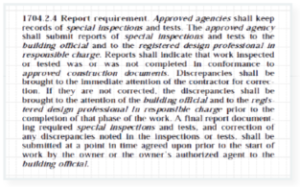
When the code uses mandatory verbiage to inform the project special inspector of their duties, the special inspector must provide the code-required special inspections and tests. They are not optional. Bear in mind that the building official is the individual the building code designates to enforce it; it is difficult to enforce the code if you are not provided with all the reports, tests, and activities related to code compliance, including specific project discrepancies. IBC Chapter 1, Section 104, goes to great lengths to define the duties and powers of the building official. The Administrative Chapter (Chapter 1) of most statewide building codes also addresses the powers and responsibilities of building officials. Remember that the statewide codes generally take precedence over the IBC when the two conflict.
So, all project contractors, project architects, project engineers, approved agencies, project special inspectors, and project fabricators should be sure to copy all building officials on every special inspection report and test related to project discrepancies, because the building code requires it. The code authorizes the building official’s duties and assigns responsibility for project code enforcement; therefore, the building official must receive copies of all special inspection reports to enforce the building code.
We’ve heard all the building official comments before. “He doesn’t understand how to perform special inspections on all those building elements.” “She doesn’t understand concrete mix design criteria.” “He doesn’t even fully understand the approved contract drawings.” The truth is, building officials don’t have to inspect every construction material or procedure. They just have to enforce compliance with the IBC code for all construction methods and procedures for all elements. Their available resources will include dozens (maybe hundreds) of special inspectors, fabricators, architects, engineers, contractors, and other building officials.
The code designates the building official as the “authority having jurisdiction” for all matters relating to the code and its enforcement. It is the duty of the building official to interpret the code and to determine compliance. Code compliance is not always easy and will require judgment and special expertise, especially when enforcing the provisions of Sections 104.10 and 104.11 in exercising this authority. While making these decisions, the building official may never set aside or ignore any other provisions of the code, including public safety provisions. Sections 104.10 and 104.11 address code modifications and alternative materials for design and materials of construction, respectively. Addressing these two changes in project construction is particularly challenging for the building official and the entire project team.
This is an excellent time to consider the rules for modifying or changing building elements during construction. If the modification or change is due to discrepancies in the building code, ONLY the building official can approve it. Code verbiage supporting this can be found in the IBC, Chapter 1, Section 104.10. Additional code language regarding alternate materials and modifications is located in the Virginia Construction Code (VCC), Section 106.3 and Section 111.2. Most statewide codes are more aggressive on this matter than the IBC. In all cases, the modifications must reflect the spirit and intent of the original code. For instance, no modifications or changes can negatively impact public safety on a project, and when it comes to safety, the code is considered sacrosanct.
If the modifications or changes are due to discrepancies in the contract documents, ONLY the RDPiRC can approve them. The RDPiRC is responsible for interpreting the project design, clarifying contract documents, and ensuring that all changes maintain the original design’s structural integrity and intent.
Another key aspect is precedence. Precedence is defined as “the condition of being considered more important than something else and, therefore, being dealt with first” or “the fact of coming or occurring before something else in time or order.” Precedence is very important in the world of building codes, particularly when conflicts arise. IBC Section 102.4 is very clear about the fact that “where conflicts occur between provisions of this code (IBC code) and the referenced codes and standards adopted by the IBC code, the provisions of the IBC code shall apply.” The IBC code takes precedence over the numerous model codes and standards that it adopts.
But what about the manufacturer’s recommendations or the manufacturer’s instructions? Often in project work, the question arises as to whether the code takes precedence over the manufacturer’s recommendations. While the code does take precedence over any conflicts between the code and its adopted model codes and standards, the code does not and cannot adopt all of the hundreds of various manufacturers’ recommendations that exist in the design and construction industry. The installer should always install the product in accordance with the manufacturer’s instructions and recommendations, as failure to do so could nullify the warranty issued to the purchaser (owner). Nevertheless, many installers and inspectors view the code as the final authority on matters of product safety and correct product installation procedures. Manufacturer’s instructions are often ignored because they are considered secondary to the applicable codes – this is wrong thinking.
Building codes often pay homage to manufacturers’ recommendations and, at times, adopt manufacturers’ installation instructions outright. The following recent project experience highlights this fact and exemplifies the importance of ensuring that the project registered design professional, contractor, and special inspector communicate effectively during construction, especially regarding the manufacturer’s instructions.
Project Information: A high-rise structural steel frame building with sprayed fire-resistant material (SFRM) being applied during cold weather conditions. While the contractor was furnishing heaters on the day of SFRM application and for the ensuing 24-hour period, he did not heat the steel substrate area to be coated with SFRM for the 24 hours preceding the application. In his mind, he was certain that he was complying with the building code.
IBC Section 704.13.4 – Temperature: A minimum ambient and substrate temperature of 40° F during and for not fewer than 24 hours after the application of the SFRM, unless the manufacturer’s instructions allow otherwise.
IBC Section 1705.14.3 – Application: The substrate shall have a minimum ambient temperature before and after application, as specified in the approved manufacturer’s written instructions. The application area shall be ventilated during and after application, as required by the written instructions of approved manufacturers.
IBC Section 704.13.2 – Manufacturer’s Installation Instructions: The application of SFRM shall be in accordance with the manufacturer’s installation instructions. The instructions shall include, but are not limited to, substrate temperatures and surface conditions; SFRM handling, storage, mixing, and conveyance; method of application; curing; and ventilation. (Note that in this specific case, the IBC code adopts the manufacturer’s recommendations and makes them code law.)
It is easy to understand that if the contractor gave a “quick-read” of IBC Section 704.13.4 and did not read the manufacturer’s installation instructions, he may not have been aware of the ambient temperature requirement of 40° F for the substrate temperatures 24 hours before the SFRM applications. While the IBC code did not specifically require that steel substrates to receive SFRM be maintained at 40° F or higher for 24 hours before the SFRM application, the manufacturer’s instructions did. The most stringent requirement wins!
Most manufacturers’ recommendations (and this project was no exception) require a minimum substrate and ambient temperature of 40° F before, during, and 24 hours after SFRM application. The temperatures at which SFRM is installed and cured are critical to its long-term fire and physical performance characteristics. SFRM is all about fire-rating. To ensure that the required fire rating is obtained in the field and equals or exceeds the code-required fire rating, it is necessary to install materials in accordance with Underwriter Laboratories (UL) listing. In this listing, minimum thickness, proper substrate conditions, method of application, and correct bonding of materials are all necessary to ensure proper performance of the SFRM. If the manufacturer’s SFRM application instructions are not followed, the density and fire ratings required by UL may not comply with the code. The manufacturer’s warranty may also be compromised if the manufacturer’s instructions are not followed.
Although the IBC code is updated every three years, it would still be impossible for the IBC code to adopt all manufacturers’ recommendations or instructions, as the array of products is constantly evolving and hundreds of new ones are added annually. The codes recognize the importance of the manufacturer’s recommendations and often adopt them. Many of the codes include code verbiage addressing the use of the manufacturer’s recommendations; some of those codes are the IBC, International Residential Code (IRC), International Existing Building Code (IEBC), International Property Maintenance Code (IPMC), and International Plumbing Code (IPC). Statewide Building Codes also generally include language that emphasizes the importance of complying with manufacturers’ recommendations for project work.
Summary Remarks
The IBC code requires following the manufacturer’s instructions and recommendations for project work. The use of used materials and equipment, as well as modified equipment, is discussed in IBC Chapter 1, Sections 104.9 through 104.10. The code is a compilation of criteria that materials, equipment, devices, and systems must meet to be suitable for a particular application. The code gives the building official the power to evaluate such materials and equipment for code compliance and, upon determination of compliance, approve them for use. The manufacturer’s instructions and recommendations are to be followed if the approval was based, even in part, on those instructions and recommendations. If technical data to determine compliance is required, it should be in the form of test reports or engineering analyses, not simply taken from a sales brochure.
While the IBC code narrative in Sections 104.9 through 104.10 addresses the power granted to the building official to approve material and equipment substitutions, as well as modifications, the RDPiRC should be included in these deliberations. The EOR should receive a copy of all applicable submittals. Most codes make it clear that the EOR must approve any changes, substitutions, and/or modifications to the project’s structural elements. It would be prudent to seek the EOR’s approval for similar changes or modifications to equipment, devices, and materials on the project as well.
Download a PDF version of this article here.
But wait! We have a lot more to say!
For a complete picture of the Code and how it relates to Special Inspections, F&R would love to provide a virtual AIA-accredited Lunch & Learn presentation to the professionals at your firm. Call the Experts at F&R! Contact: Alan S. Tuck, Director of Code Compliance & Training | T 540.344.7939 | M 540.798.4440 | E atuck@fandr.com