
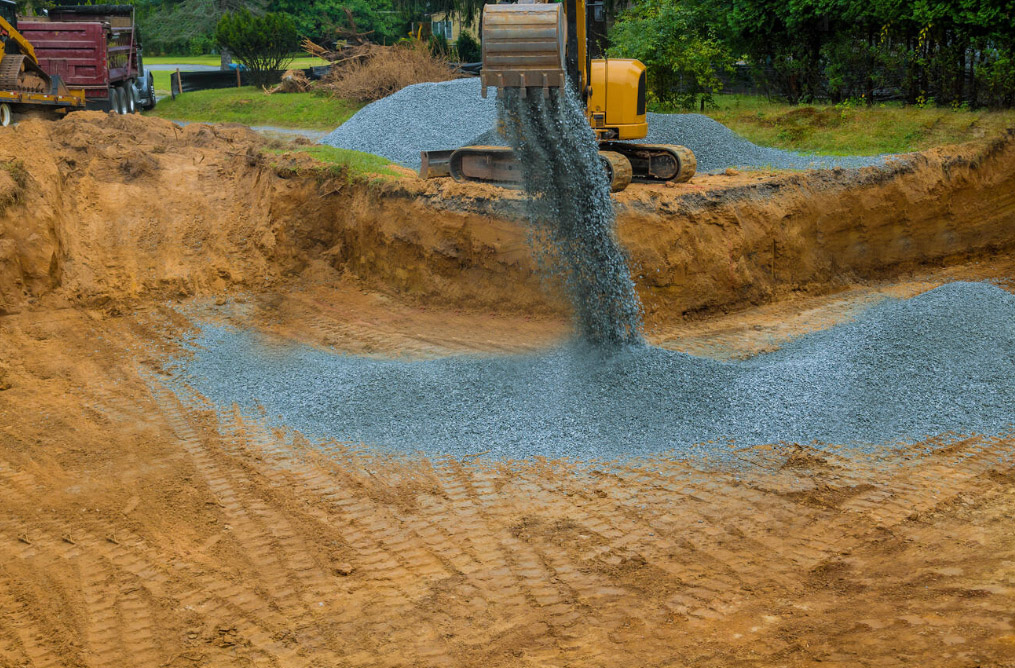
It may surprise you to know that most people in the design and construction community (including concrete ready-mix producers) do not consider flowable concrete to be concrete at all. A more popular and realistic term for flowable concrete is “controlled low-strength material,” or CLSM, especially when it is used as a replacement for compacted fill on a project. In Chapter 2 of the IBC Code, CLSM is defined as a “self-compacted, cementitious material used primarily as a back-fill in place of compacted fill.” It is often referred to as “flowable fill.”
The more common uses of CLSM are related to project earthwork operations, especially in the geotechnical discipline, where it is used as a self-compacting, high-mobility backfill alternative to traditional compacted soil. The desired compressive strength of the CLSM for these uses generally ranges from 50 psi to 300 psi, as addressed in ACI 229R. Compressive strengths of 50 psi to 150 psi are considered within the range that allows future excavation with hand tools, while 150 psi to 300 psi may require a standard backhoe for excavation. Some of the key earthwork and geotechnical applications of CLSM are:
- Replacing unsuitable fill materials beneath and adjacent to shallow foundations
- Utility trenches backfill (filling sewer, water, and utility trenches)
- Pipe bedding and encasement, where it provides superior support for pipes and conduits by filling the void underneath the pipe, ensuring consistent load distribution without requiring compaction
- Underground tank abandonment, where it is used to fill decommissioned underground storage tanks (USTs) to prevent collapse, filling the void completely without dangerous entry requirements
- Void filling/Grouting, filling abandoned sewers, tunnels, manholes, sinkholes, and other inaccessible underground voids
- Erosion control, placed around pilings and in areas prone to soil erosion
Chapter 18 of the IBC Code, entitled “Soils and Foundations,” recommends CLSM (Sec. 1804.3) and states that it need not be compacted, acknowledging its self-leveling, non-segregating properties. This section also states that excavation outside the foundation can be backfilled with soil or CLSM. The use of CLSM beneath or adjacent to shallow foundations impacts bearing pressure. ACI 229R, Chapter 1, notes that CLSM has an allowable bearing pressure of 50 to 100 psi, making its load-supporting capacity equivalent to a well-compacted fill. Section 1803.5.9 of the IBC does require some minimal information to be included in the geotechnical report if shallow foundations bear on CLSM, and those minimum report requirements are:
- Specifications for the preparation of the site prior to placement of CLSM
- Specifications for the CLSM (ACI 229R, Section 2; 6.4 is often cited for proportions)
- Laboratory or field test method(s) to be used to determine the compressive strength or bearing capacity of the CLSM
- Test methods for determining the acceptance of the CLSM in the field (ASTM D4832)
- Number and frequency of field tests required to determine compliance with the bullet point above
Possible additional code compliance criteria for the CLSM are addressed in the commentary of IBC Section 1803.5.9. This additional information addresses field quality control testing for CLSM, including sampling, molding test specimens, unit weight determinations, etc. Most flowable fill used during new construction work is CLSM with low compressive strength, as one of the major qualities the user desires is that it be easy to excavate in the future (pipe bedding, utility trenches, etc.). CLSM with compressive strengths below 150 psi is generally required if future excavatability is desired. If the CLSM is to be used for structural reasons (mud mats, foundation sub-footings), compressive strengths of 300 psi to 1,200 psi are generally specified, and it is not easily excavated. When the compressive strength of the cementitious mixture is in the range of 300 psi to 1,200 psi, the mixture exhibits more qualities of a “lean concrete” mixture. Lean concrete is a low-strength concrete mixture with a high ratio of aggregate to cement, typically containing less than 10% cement (absolute volume).
Some examples of the use of CLSM for key structural and high-strength applications are:
- Foundation support and subgrade stabilization, used under structural foundations where unstable soil is encountered and the poor soil is excavated and replaced with CLSM to provide a stable, high-bearing capacity base
- Void filling under slabs and pavements, filling accidental or intentional voids (under newly placed pavement or in abandoned utility lines) to provide solid support and eliminate future sinkholes
- Backfill against retaining walls/structures, enabling rapid backfilling behind retaining walls or bridge abutments without heavy, vibratory compaction equipment, reducing lateral pressure during placement
- Structural pipe bedding, providing superior support around the bottom and sides of pipes and preventing structural failure due to uneven settling
Remember that flowable concrete or CLSM is not really concrete. Concrete must comply with numerous code requirements set forth in ACI 318 (the concrete code). Some of these criteria include minimum cement content, maximum water-cement ratio, minimum compressive strength, air content parameters, aggregate quality tests, etc. CLSM does not have to comply with any of the ACI 318, Chapter 19, criteria for concrete mixtures because it is not concrete but rather is a controlled low-strength cementitious material. CLSM proportions should be developed in accordance with ACI 229R unless the proportions are stipulated and defined in the project contract documents.
The first known uses of flowable fill occurred in the mid-1960s and early 1970s due to problems associated with soil compaction during utility construction and soil backfilling operations in utility trenches. Obtaining proper compaction of the backfill in trenches during the placement of pipe and utilities was labor-intensive and time-consuming, and settlement of the near-surface soils covering the pipe and utilities was far too common. This is the construction situation that established the need for, and led to the creation of, flowable fill.
ACI 229R became effective in 1994 to address the need for flowable fill. CLSM offers several primary advantages in construction, acting as a superior alternative to compacted soil or gravel in many applications. Key benefits include eliminating mechanical compaction, increasing construction speed, and reducing the time needed to fill tight, irregular spaces in accordance with load-bearing criteria established by the geotechnical engineer-of-record.
Primary advantages of CLSM in construction:
- No compaction required: CLSM is self-leveling, self-compacting, fluid material that flows into place without needing mechanical vibration, tamping, or roller compaction
- Reduced labor and equipment costs: CLSM requires fewer personnel and eliminates the need for heavy, on-site compaction machinery, which speeds up project timelines
- Minimum settlement: CLSM does not form voids during placement and does not settle or rut over time, preventing future failures or sinkholes
- Excellent for confined spaces: CLSM is ideal for filling narrow trenches, abandoned pipes, tunnels, or areas around irregular underground structures where compaction equipment cannot reach
- All-weather construction: CLSM can be placed in cold weather or in wet, submerged trenches; it will displace standing water, reducing the need for dewatering pumps
- Improved worker safety: Workers do not need to enter trenches for compaction efforts, which reduces exposure to potential cave-ins
- Faster installation and quick return to traffic: CLSM sets rapidly (often within 30 to 60 minutes) and can support traffic loads within a few hours, significantly reducing downtime in road repair projects (Note – the addition of accelerators to CLSM mixtures at a ready-mix plant will accelerate set times and early strengths)
Finally, the term CLSM is used to describe a family of mixtures for various applications. CLSM mixtures can also be developed for anti-corrosion fills, electrically conductive fills, low-permeability fills, thermal fills, and durable bases for pavement or mud slabs. Material proportions for CLSM vary depending on the project need for which they are created, but compliance with ACI 229R is recommended to ensure a modicum of consistency.
Reference Codes and Standards cited in this article:
International Building Code (IBC)
Building Code Requirements for Structural Concrete (ACI 318)
ACI 229R, Report on Controlled Low-Strength Materials (CLSM)
______
But wait! We have a lot more to say! For a complete picture of the Code and how it relates to Special Inspections, F&R would love to provide a virtual AIA-accredited Lunch & Learn presentation to the professionals at your firm.
Trouble Deciphering the Code? Call the Experts at F&R! Alan S. Tuck, Director of Code Compliance & Training
T 540.344.7939 | M 540.798.4440 | atuck@fandr.com
______