
Defining and understanding project special inspections according to the International Building Code (IBC) is not easy. This is especially true when addressing the inspections and tests required of the special inspector by the building code as well as inspections required by the project contract documents. Special Inspections are, essentially, quality assurance reviews mandated by the International Building Code (IBC) Chapter 17 to ensure complex structural and fire-safety elements are built correctly. They require certified third-party professionals to monitor specific building activities, independent of the contractor building the project. While many of these special inspections and tests are cited in IBC Chapter 17 (Special Inspections and Tests), many more are identified as code-required inspections and tests in the numerous model codes and standards adopted by IBC and listed in IBC Chapter 35 as “Referenced Standards.”
So what exactly are special inspections? IBC defines special inspections as the “inspection of construction requiring the expertise of an approved special inspector in order to ensure compliance with this code (IBC) and the approved construction documents.” The most important part of this definition is that the special inspector must endeavor to ensure compliance of the work with the approved construction documents as well as the IBC code. The design and construction industry comprises many people who do not realize that the special inspector must observe construction procedures and materials for compliance with the construction documents as well as the building code. While most special inspections are provided on structural elements, they are also required by the code for non-structural systems like fireproofing, smoke control, exterior cladding, and other non-load-bearing components.
Project special inspections provided in accordance with the IBC code are complicated. Breaking down this complex topic into actionable, digestible single steps may provide an easy starting point for understanding the system. Three important items need to be addressed before project construction begins to improve the special inspection process, make it more lucid, and ensure success. Those three items are:
Statement of Special Inspections (SSI): The foundational document outlining which inspections and tests are required for your specific project. Code requires that the SSI be prepared by the registered design professional in responsible charge (RDPIRC) of the project being built. Code requires that every project have an SSI, which must be submitted by the applicant when the building permit is applied for (IBC Section 1704.2.3). The building permit is not supposed to be issued without the presentation of the project SSI along with the contract documents, geotechnical report, etc.
Discrepancy Resolution: The special inspector shall report any discrepancy that is discovered immediately to the contractor for correction. The special inspector shall maintain a discrepancy list, and all outstanding discrepancies shall be reported to the building official and the registered design professional in responsible charge before the completion of that phase of the work (IBC Section 1704.2.4). All outstanding discrepancies should be resolved before the completion of the project.
Special Inspections Preconstruction Meeting: This meeting should be held before construction begins to discuss code-required special inspections and any anticipated problems. The SSI and Chapter 17 of the IBC code should develop the agenda for the meeting. All project team members should attend. The IBC code does not explicitly require a special inspections preconstruction meeting. However, many local jurisdictions, universities, and municipal building departments do require one through code amendments or standard administrative policy.
If the project team has a good handle on the SSI and discrepancy process, and participates in a proactive preconstruction meeting, most typical special inspection and testing problems will be resolved before project construction phases begin. Listing all code-required special inspections and tests in the project SSI is practically impossible, and these items should be covered in the preconstruction meeting. While IBC, Chapter 17 lists many of the code-required special inspections, most special inspections and tests are required by the IBC-adopted model codes and are not listed or referred to in Chapter 17. Most of the sources of this code-required criteria not covered in IBC Chapter 17 or other IBC chapters are found in IBC adopted model codes and standards listed in IBC Chapter 35. The edition (issue year) of the model codes listed in IBC Chapter 35 is the specific edition that must be used on the project. Using a model building code or standard edition OTHER than the edition listed in Chapter 35 requires the approval of the building official. Only the building official can approve this variance.
Major Construction Disciplines Requiring Special Inspections
1. Soils and Earthwork (Geotechnical)
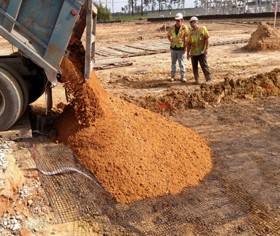
Governed primarily by IBC Chapter 17, Section 1705.6, and the approved geotechnical report, this discipline ensures that the ground supporting the structure has the required load-bearing capacity. The IBC code adopts the geotechnical report’s earthwork recommendations and is just as enforceable as any other code-required special inspections. IBC Chapter 18 (Soils and Foundations) also includes code-required criteria for project earthwork phases as well as for the contents of the project geotechnical report.
- Key Focus Areas: Verification of site soil conditions, classification of materials, monitoring of excavation depths, and continuous testing/inspection during the placement and compaction of structural fill beneath the The IBC code adopts an approved geotechnical report, and field tests and inspections must verify that the geotechnical engineer’s recommendations or records are complied with. IBC Chapter 18 includes code-acceptance criteria for project earthwork phases.
2. Foundations (Deep and Shallow)
Covered under IBC Sections 1705.7, 1705.8, and 1705.9, foundation special inspections vary depending on whether the building relies on standard spread footings or deep foundation elements. The specific type of deep foundation also determines the frequency and magnitude of special inspections. These tables also require special inspections on steel and concrete elements of deep foundations. Section 1705.9 requires special inspections on helical pile foundations.
- Key Focus Areas:
- Driven Piles: Monitoring pile material integrity, driving equipment parameters, and tracking blow counts/final set
- Drilled Piers/Caissons: Verification of shaft diameters, bottom cleanliness, plumbness, and continuous concrete placement
3. Structural Concrete
Detailed to some degree under IBC Section 1705.3 and Table 1705.3 and referencing ACI 318, concrete inspections and tests are among the most extensive on the project site. Most of the key code-acceptance criteria, relative to ACI 318, are found in ACI Chapters 19 and 26. ACI 301, “Specifications for Structural Concrete,” also contains a plethora of testing and inspection criteria. While ACI 301 is not code, it is the foundation of all concrete specifications in the land, and the special inspector must ensure compliance with the contract documents as well as compliance with the building code. The special inspections required on plastic concrete are continuous in nature and include concrete curing and in-place concrete protection compliance.
- Key Focus Areas:
- Field inspection and testing of plastic concrete (slump, air content, temperature, and sampling for compressive strength cylinders).
- Ensuring that the concrete placed on the project complies with ACI Chapter19 (exposure class) criteria and with the approved project concrete mix designs is required
- Verifying reinforcing steel placement, size, clearance, and post-tensioning tendon anchorages; rebar is inspected for compliance with the Concrete Reinforcing Steel Institute (CRSI) standards as required by most contract documents
- Inspection of concrete placement methods and post-installed anchor installations
- Compliance with hot and cold weather requirements as well as proper concrete curing and concrete protection as stipulated in ACI 318, Chapter 26
- Perform all code-required inspections and tests on plastic concrete specified in IBC Table 1705.3
- Perform all concrete special inspections specified in IBC Table 1705.3, such as welding of rebar, concrete dowels, concrete curing techniques, placing and finishing procedures, and pour location
4. Structural Steel and Metal Decking
Special inspections are under IBC Section 1705.2 and IBC Chapter 22, and model codes AISC 360 (Chapter N) and AWS D1.1 are primary sources for code-acceptance criteria for both shop fabrication inspections and field erection inspections and testing. Generally speaking, AISC 360 advises what inspections are required, and AWS D1.1 and the Research Council on Structural Connections (RCSC) advise on how to perform the inspections. Cold-formed steel inspections are to be performed according to AISI S240.
- Key Focus Areas:
- Special inspector to verify that welders are qualified in accordance with AWS D1.1 and properly certified for the project regarding proper Welding Procedure Specifications (WPS). AWS D1.1 clause 6.4.1 states “The inspector shall allow welding to be performed by only welders, welding operators, and tack welders who are qualified in conformance with the requirements of clause 4 (Qualifications) …”
- Nondestructive testing (NDT) of welds (ultrasonic, magnetic particle, or radiographic)
- Verification that steel fabrication shop complies with IBC Section 1704.2.5.1
- Verification of welded and bolted connections according to AISC 360, Chapter N, and RCSC
- Visual inspection of all welds according to AWS D1.1 and Table 6.1
- Inspection of structural steel framing, cold-formed steel framing, and steel deck installation
- Verification of all welded connections in accordance with AWS D1.1 and AISC 360
- Cold-formed steel; Provide special inspections according to AISI S240, Chapter D, which is entitled “Quality Control & Quality Assurance”

5. Masonry Construction
Special inspections should be performed in accordance with IBC Section 1705.4 and TMS 402/602. Masonry inspections and tests apply to concrete masonry units (CMU), clay brick, mortar, grout, reinforcement bars, joint reinforcement, anchors, ties, and various accessories. When applicable, masonry fire-resistance ratings should comply with appropriate requirements of IBC Chapter 4 and Table 5.1a of ACI 216.1 (Determining Fire-Resistance of Concrete and Masonry Construction Assemblies).
- Key Focus Areas:
- Before construction, verify that submittals are in compliance as listed in Article 1.5
- Perform gradation on project masonry sand, and if masonry sand does not comply with ASTM C144 grading limits, then a laboratory mix design is required to verify that mortar made with this sand complies with the aggregate ratio, water retention, air content, and compressive strength requirements of the property specifications of ASTM C270
- Before construction, verify f’m to determine compliance of masonry system components (mock-up panels required by unit strength method – TMS 602 Article 1.4 B.2)
- Verifying proportioning of site-prepared mortar and grout for compliance with ASTM C270 (Mortar) and ASTM C476 (Grout); place grout according to TMS 602 Article 3.5
- Provide the special inspections specified in TMS 602, Table 3 (Minimum Verification Requirements) and Table 4 (Minimum Special Inspection Requirements)
- Placement of joint reinforcement, wall ties, and masonry anchors according to TMS 602, Article 4
- Verify that mortar joints are placed and tooled in thicknesses according to Article 3.3B
- Sample and test masonry units to verify conformance with ASTM C90, Article 1.4
6. Sprayed Fire-Resistant Materials (SFRM)
Detailed under IBC Chapter 17, Section 1705.15, the basic SFRM special inspections are addressed as well as related IBC code acceptance criteria. IBC Chapter 4, specifically Table 403.2.3, must be reviewed to understand minimum SFRM bond strengths in high-rise buildings. This discipline speaks to passive fire protection and offers mandatory inspections and tests to ensure that the SFRM is correctly applied to structural steel and floor/roof assemblies.
- Key Focus Areas:
- Substrate conditions before application of SFRM
- SFRM Thickness verification, density (pounds per cubic foot), and bond strength (adhesion/cohesion tests) of fireproofing material
- Condition of finished application (final walk-through to check for cracks, spalls, or loose SFRM)
- IBC Chapter 7, Section 704.13, addresses importance of temperature control during SFRM application
- IBC Section 1705.18 focuses on architectural and MEP pass-throughs; inspection of through-penetration firestop systems, fire-resistant joint systems, and perimeter fire containment barriers to ensure they match tested and listed engineering designs; and verification of seismic force-resisting systems (SFRS), structural isolation systems, and designated seismic systems
6. Wood and Mass Timber
Covered under IBC Section 1705.5 and IBC Chapter 23, wood inspections target high-load or specialized timber construction. Table 1705.5.3 lists required special inspections of mass timber elements in Types IV-A, IV-B, IV-C construction as defined in IBC Chapter 6, Section 602.4, and Table 601.
- Key Focus Areas:
- Fabricated items such as glued-laminated (glulam) timber, cross-laminated timber (CLT), and prefabricated wood trusses
- Specialized high-load diaphragms, shear walls, and structural connections using heavy hardware or proprietary connectors
Seismic-force-resistant elements and wind-resistance systems are not addressed in this article to minimize length, but that does not diminish the importance of the special inspections required for these building elements by the IBC code in Chapters 16, 17, and 18, not to mention the ASCE 7 model code. Even in the seven major construction disciplines that are addressed within this article, only a fraction of the code-required tests and inspections are listed. There are dozens (probably hundreds) of individual tests and inspections required by the building code that are not mentioned in this missive, but the model codes highlighted within the article narrative will provide the sources for most of the individual tests and special inspections not listed within the parameters of the article.
The IBC code requires dozens of specific construction material tests and construction material procedures through the designation of the American Society for Testing and Materials (ASTM). Almost all building disciplines (earthwork, concrete, masonry, reinforcing steel, structural steel, SFRM, and others) require ASTM laboratory and field tests to verify IBC code compliance. IBC Chapter 35, entitled “Reference Standards,” lists more than 300 ASTM standards. The implementation of these ASTM standards is mandatory when triggered by the construction of corresponding structural elements or construction materials on a project. When referenced by the IBC code, a specific ASTM standard for testing materials OR construction procedures becomes a legal code requirement for structural safety.
But wait! We have a lot more to say! For a complete picture of the Code and how it relates to Special Inspections, F&R would love to provide a virtual AIA-accredited Lunch & Learn presentation to the professionals at your firm.
Trouble Deciphering the Code? Contact the Experts at F&R! Alan S. Tuck, Director of Code Compliance & Training
E atuck@fandr.com | T 540.344.7939 | M 540.798.4440