
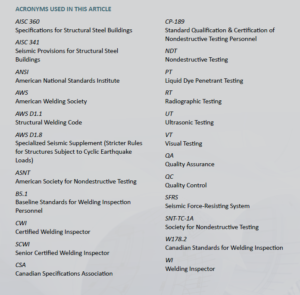
Discombobulation occurs when the different entities involved in the structural steel portion of a construction project discuss the CODE and welding inspector qualifications. This confusion is not caused by AWS D1.1 (the Welding Code) because AWS D1.1 has long defined and specified welding inspector qualification requirements. This is especially true since the 1996 edition of AWS D1.1, which incorporated explicit qualification requirements for welding inspectors. The 1996 edition defined specific formal qualification and certification criteria for the individual performing the inspection. The confusion starts because the International Building Code (IBC) does not appear to adopt AWS D1.1 in Chapter 35. The original 2000 edition of the IBC code and subsequent editions adopted AWS D1.1 until the 2009 edition of the IBC code, when AWS D1.1 was deleted from Chapters 17 and 35 of the IBC code as a referenced code.
By 2009, AISC 360 had expanded its own standards—specifically introducing robust quality control and inspection criteria into AISC 360 (Chapter N) and AISC 341 (Seismic Provisions for Structural Steel Buildings)—and the IBC model code process shifted reliance from AWS D1.1 to AISC 360. 2009 editions of the IBC code (and later ones) point directly to AISC 360 for structural steel requirements rather than maintaining a separate, direct link to AWS D1.1 in the main text of Chapters 17 and 35. Because AISC 360 and AISC 341 incorporate AWS D1.1 and AWS D1.8 by reference, compliance with the AWS D1.1 standards remains a mandatory legal and technical obligation during structural steel fabrication and erection, as well as QC/QA inspection procedures. Not only were references to AWS D1.1 deleted from IBC Chapters 17 and 35, but so were other pertinent inspection acceptance criteria contained in earlier editions of the IBC and Chapter 17, including the special inspection requirements related to steel stairs, railing systems, and ladders.
Comparison of Codes
Most welding codes provide some basis for qualifying welding inspectors and NDT Technicians. It is often confusing to know what qualifications a specific project requires, so this summarizes some of those requirements. We will look at D1.1, D1.3, D1.5, and D1.8, all codes applicable to the welding inspection work F&R performs. These welding inspections are generally broken into two categories: 1) Visual Inspection, sometimes referred to as visual testing (VT); and 2) non-destructive testing (NDT), including magnetic particle testing (MT), liquid dye penetrant testing (PT), radiographic testing (RT), and/or ultrasonic testing (UT), among other NDT methods. As always, the limits discussed here are code-specific, but you must always refer to your project’s contract documents to verify compliance with the approved construction documents, in addition to applicable codes.
Side-by-Side Snapshot — D1.1, D1.3, D1.5, D1.8 QC, D1.8QA Codes
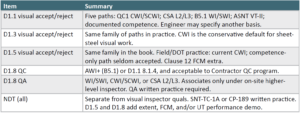
1. AWS 1 / D1.1M — Structural Welding Code—Steel
Primary editions referenced: D1.1:2020 (widely used; CWI Part C codebook) and D1.1:2025. Inspection is in Clause 8. Inspector qualifications are in 8.1.4.
Who must be qualified?
Inspectors responsible for acceptance or rejection of material and workmanship based on visual inspection shall be qualified. If the Engineer requires a basis other than those listed in 8.1.4.2, that basis shall be designated in the contract documents (8.1.4.1).
Acceptable basis (Clause 8.1.4.2)
- Current or previous CWI or SCWI certification per AWS QC1.
- Current or previous CSA W178.2 Level 2 or Level 3 Welding Inspector.
- Current or previous qualification as WI or SWI per AWS B5.1.
- Current or previous ASNT SNT-TC-1A VT Level II, or ANSI/ASNT CP-189 equivalent.
- An individual who, by training or experience or both, in metals fabrication, inspection and testing, is competent to perform inspection of the Work. The basis shall be documented.
- The 2020 edition expanded the list versus earlier editions (added B5.1 and ASNT VT-II paths).
- Assistant inspectors: parallel, slightly lower requirements in 8.1.4.5 (also includes B5.1 and ASNT options).
- Visual acuity (8.1.4.6) aligned more closely with QC1 and ASNT (near vision typically Jaeger J2 or equivalent at 12 inches; medical alternatives allowed).
- NDT personnel are separate: employer-written practice per SNT-TC-1A or CP-189. A visual-inspector credential does not by itself qualify someone to perform or accept NDT.
- Contractor’s Inspector (QC) and Verification Inspector (QA) both must meet 8.1.4. Same list for both roles.
NOTE: The American Welding Society (AWS) has standardized the terminology across all its codes and specifications to maintain document uniformity. Instead of dividing books into “chapters” or “sections,” AWS officially uses the term “Clause” for the primary numbered divisions of its standards, followed by “Subclause” for subordinate sections.
2. AWS D1.3 / D1.3M — Structural Welding Code—Sheet Steel
Current edition: D1.3/D1.3M:2025 (Seventh edition; revised 2018). Covers sheet/strip steel ≤ 3/16 in. (≈ 5 mm) nominal thickness and HSS walls < 1/8 in. Inspection is in Clause 8.
Public excerpts do not reprint a five-item list as clearly as D1.1:2020. In practice, the D1 family is aligned. Visual inspectors who accept or reject work must be qualified; the Engineer may specify the basis in the contract.
Typical accepted paths:
- CWI or SCWI per QC1
- CSA W178.2 Level 2 or 3
- WI or SWI per B5.1
- ASNT SNT-TC-1A or CP-189 VT Level II
- Documented training and/or experience demonstrating competence for the work
Acceptable basis (Clause 8.1.4.2)
- Sheet-steel work (arc-spot, arc seam, plug, thin-gauge fillet/groove, galvanized sheet is visual inspection heavy; CWI is the least-disputed credential
- When D1.3 is used with D1.1, Annex A of D1.3 and the contract state which code governs each joint type
- NDT, if specified, follows SNT-TC-1A or CP-189
3. AASHTO/AWS D1.5M / D1.5 — Bridge Welding Code
Widely used editions: 2020 (CWI Part C codebook, including Clause 12) and 2025 (9th edition). Inspection is Clause 8. Fracture-critical members are in Clause 12.
Code language follows the D1-family pattern: personnel who accept or reject by visual inspection shall be qualified. The Engineer or Owner/DOT may specify a different basis in the contract.
Typical accepted basis:
- CWI or SCWI per QC1.
- CSA W178.2 Level 2 or 3.
- WI or SWI per B5.1.
- ASNT SNT-TC-1A or CP-189 VT Level II.
- Documented competence — rarely accepted on DOT work without written Owner approval.
Bridge-specific tightening (practice more than Clause 8 text):
- State DOT / Owner specs often require a current CWI (sometimes with a D1.5 endorsement) for shop and field QC/QA
- QA inspectors are frequently limited to CWI/SCWI or WI/SWI; CAWI only under CWI
- Clause 12 (FCM): extra documentation, more stringent NDT extent and acceptance, named inspector/UT lists, 100% visual plus specified UT of CJP grooves in tension/reversal zones
- NDT personnel: SNT-TC-1A or CP-189 plus project-specific UT procedure and often performance demonstration
- AWS D1.5 endorsement for existing CWIs/SCWIs is commonly requested; D1.5 itself does not require it but can support recertification
4. AWS D1.8 / D1.8M — Structural Welding Code—Seismic Supplement
Current edition: D1.8/D1.8M:2025 (5th edition; revises 2021). Supplements D1.1 for welded joints in the seismic force-resisting system (SFRS) designed to AISC 341. Inspection is in Clause 7. D1.1 still applies except where D1.8 is more stringent.
D1.8 splits QC and QA and restricts associates and the “competent individual” path on the QA side.
QA welding inspectors (7.2.1)
Must be one or more of:
- WI or SWI per B5.1 — except AWI only under direct supervision of a WI who is on site and available
- CWI or SCWI per QC1 — except CAWI only under direct supervision of a CWI who is on site and available
- CSA W178.2 Level 2 or 3 — except Level 1 only under direct supervision of a Level 2 who is on site and available
QA agency written practice is required (Clause 7.3)
QC welding inspectors (7.2.3)
- AWI or higher per B5.1 or otherwise qualified under D1.1 inspector provisions (D.1.1.8.1.4) and acceptable to the Contractor’s QC program. Shop QC may use the full D1.1 list. Independent acceptance of SFRS welds remains the QA inspector’s job.
Other D1.8 inspection items
- 7.1 assigns “observe/perform” documentation of tasks for SFRS fabrication and erection (According to ACI 360, observe means that items are to be observed on a random basis, and perform means for the inspector “to perform these tasks for each welded joint or member.”)
- Annex F: supplemental ultrasonic technician qualification; D1.8 is often used as the UT Level II performance-demonstration/grading scheme on seismic CJP work
- Demand-critical welds, heat-input envelope testing, intermix CVN, restricted-access welder tests, k-area, lamellar tearing, and cope/access-hole rules add hold points beyond D1.1
- AISC 341 Chapter J uses essentially the same QC/QA split
5. Comparison — D1.1 vs D1.8
D1.8 does not replace D1.1. It adds and tightens rules for SFRS joints.
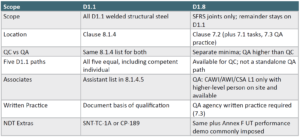
On one project: D1.1 Clause 8 for ordinary members; D1.8 Clause 7 for SFRS and demand-critical welds. Contract and Engineer can raise either minimum; they rarely lower D1.8 QA.
Short version: D1.1 gives five equal paths, including experience-only. D1.8 keeps those paths for QC but requires WI / CWI / SCWI or CSA Level 2–3 for QA, with associates only under live on-site supervision.
6. Comparison — D1.1 vs D1.5
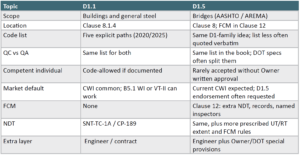
A building is D1.1 only. A steel bridge is D1.5 (D1.1 only where D1.5 points to it). Do not treat a D1.1 qualified inspector as automatically qualified for a DOT bridge without checking special provisions.
Short version: The code lists look alike. D1.1 still allows five paths, including experience-only. D1.5 in the field is almost always current CWI plus Owner-approved NDT techs, with Clause 12 and DOT specs doing the real tightening.
But wait! We have a lot more to say! For a complete picture of the Code and how it relates to Special Inspections, F&R would love to provide a virtual AIA-accredited Lunch & Learn presentation to the professionals at your firm. Special thanks to Brian Pratt, Director of Metals and Nondestructive Testing at F&R, for his collaborative efforts in developing this technical article with Speaking in Code author Alan Tuck.
Trouble Deciphering the Code? Contact the Expert at F&R! Alan S. Tuck, Director of Code Compliance & Training | E atuck@fandr.com | T 540.344.7939 | M 540.798.4440